US-Iran Exchange Sends Futures Traders to the Right Market
What the Tape Is Telling You This Morning
Monday, August 31, 2026 opens with the kind of macro pressure that reminds every trader why instrument selection matters as much as setup selection. Reuters is reporting that Wall Street is bracing for a lower open as renewed Middle East hostilities have revived rate-hike speculation in the bond market. Separately, Yahoo Finance is reporting that US and Iranian forces have exchanged fire for the first time in roughly a month, sending crude prices sharply higher overnight.
That creates an unusual split on the board this morning. According to Yahoo Finance, gold is actually sinking in the immediate aftermath of the US strikes on Iran — a counterintuitive move that speaks to dollar strength and liquidation pressure rather than the typical safe-haven bid. Meanwhile crude is surging on the supply disruption narrative.
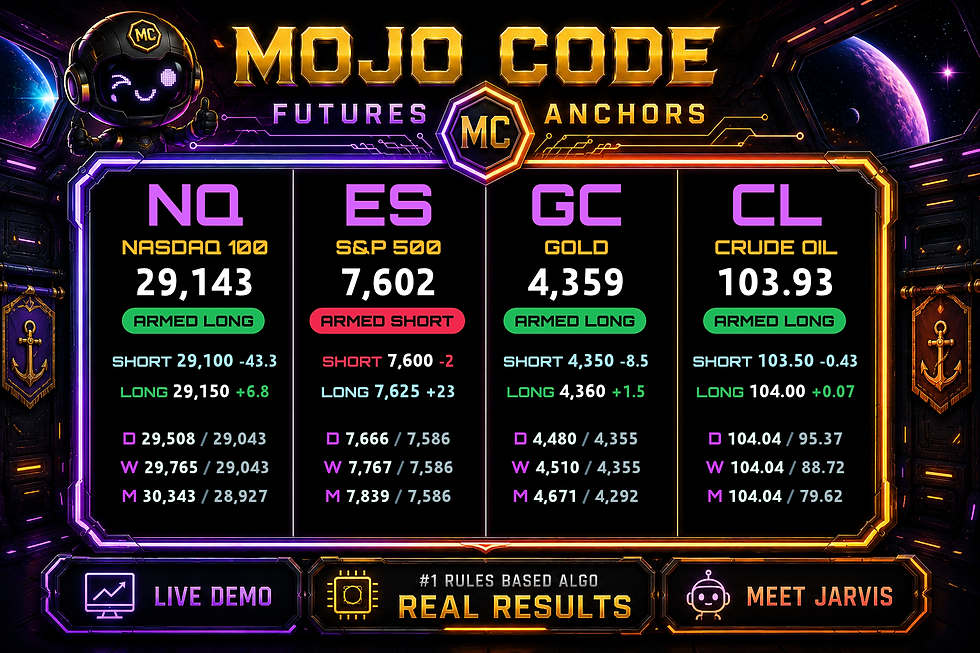
The MOJO CODE™ anchor read this morning is a Gunslinger setup. NQ is armed short toward 29,450. ES is armed short toward 7,700. GC is armed long toward 4,510. CL is armed short toward 86.00. That last one deserves a second look in context. The armed short on CL toward 86.00 is not a call against the geopolitical surge — it is the anchor. The MOJO CODE™ discipline is to trade toward the anchor and stay flat in the middle. You do not chase the spike. You wait for price to tell you where it wants to go.
According to Reuters, equities futures were pointing lower ahead of the open as traders reassessed the rate environment against a deteriorating geopolitical backdrop.

Why Serious Traders Eventually End Up in Futures
If you came from the stock market, you already know the frustration. You found a setup at 11:00 AM, you traded it, you were right, and then you did it again at 1:30 PM, and again near the close. Three round trips in five days and your broker locked your account with a pattern day trading flag. You did not lose money. You made money. And the rule still stopped you.
That is the Pattern Day Trader rule, or PDT. The Financial Industry Regulatory Authority requires that any trader who executes four or more day trades within five business days in a margin account must maintain a minimum account equity of $25,000. Fall below that and you lose same-day trading privileges. You are not penalized for bad trades. You are penalized for trading too often regardless of your results.
That constraint has nothing to do with your skill. It has nothing to do with the quality of your read. It is a structural cage built around the retail stock trader, and it pushes more disciplined operators out of equities and into futures every single year.
The Margin Math Nobody Shows You
Beyond the PDT rule, the margin structure in stocks works against the active trader in a different way. Retail stock traders on margin get 4:1 intraday leverage, which sounds generous until you understand the cost. That leverage runs on a margin loan. You pay interest on it. You are borrowing capital from your broker, and that cost compounds against your P&L every day you hold a leveraged position.
Futures margin is different in kind, not just in degree. When you post margin to hold an NQ contract, you are not borrowing money. You are posting a performance bond. No interest accrues. The capital you set aside is yours, acting as a good-faith deposit against your position. Overnight, the exchange marks your position to market and adjusts your account in real time through the settlement process. The cost structure is fundamentally different from a stock margin loan, and over the course of an active trading year that difference shows up clearly in the numbers.
The Around-the-Clock Advantage
This morning's tape proves the point. The US-Iran exchange happened overnight. Gold and crude were moving hard before 6:00 AM Eastern time. If your entire trading life lives inside the 9:30 to 4:00 window of the stock market, you woke up this morning and the move was already done. You are now managing someone else's decision.
Futures traders were awake for that move. NQ futures, ES futures, GC, CL — all of them trade nearly around the clock on CME Globex. The session opens Sunday evening and runs with only brief daily maintenance windows through Friday afternoon. That is not just a convenience feature. It is a structural edge in a world where geopolitical events, central bank decisions, and economic data releases do not schedule themselves around the New York Stock Exchange's bell.
The MOJO CODE™ framework is built for this environment. The anchors are set the night before. When the tape moves at 2:00 AM on a geopolitical headline, you already know your levels. You know where you are going and you know where you are staying flat.
The Tax Structure Most Traders Ignore Until April
There is one more piece that rarely gets discussed until someone's accountant mentions it in March. Futures contracts that fall under Section 1256 of the US tax code receive what is called the 60/40 treatment. Sixty percent of gains are taxed at the long-term capital gains rate. Forty percent are taxed at the short-term rate. This applies regardless of how long you held the position. You could hold an NQ contract for thirty seconds and sixty percent of that gain still qualifies for the lower rate.
Compare that to a stock day trade, where one hundred percent of the gain is short-term and taxed as ordinary income. For a consistently profitable trader, the 60/40 rule is not a minor footnote. It is a meaningful difference in after-tax returns that compounds over years of active trading.
This is not financial advice and it is not tax advice. Talk to a qualified tax professional about your specific situation. But understand that the BOPE™ framework — Built On Positive Expectancy — accounts for all the inputs that affect your actual outcome, and taxation is one of them.
The Constraint Is the Signal
Nobody migrates from stocks to futures because the charts are prettier. They migrate because the structure of stocks creates friction that has nothing to do with trading skill, and eventually that friction becomes the dominant factor in their results.
PDT rules cage the active trader. Margin interest erodes the leveraged position. The 9:30 bell closes the door on half the world's market-moving events. And ordinary income tax treatment takes a larger cut of every winning day trade.
Futures do not eliminate risk. Nothing does. But they remove constraints that are entirely external to your edge. That is the MOJO CODE™ principle at work today as it is every morning: understand the environment you are operating in before you touch the first setup. The tape this morning has NQ armed short toward 29,450 and CL armed short toward 86.00. Know your anchors, trade toward them, and stay flat in the middle. That is the discipline. The rest follows from the structure.
Trade these live with us. The VIP Room is open at 9:00 AM ET. Come see MOJO CODE™ work in real time: https://www.mojocodeai.com/vip-chat
MOJO CODE™ is a proprietary trading indicator system. Educational content only, not financial advice. Trading futures involves substantial risk of loss.
Keep it profitable,
ProTrader Mike


Comments