U.S.-Iran Conflict Sends Oil Surging — Trade the Anchor, Not the Noise
What the Tape Is Doing This Morning
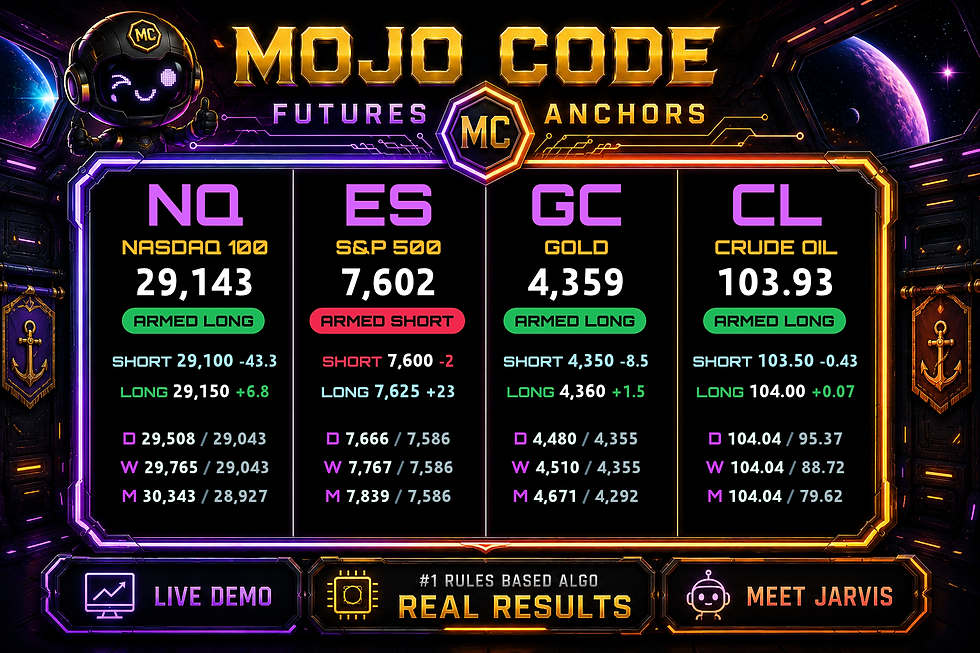
Crude is moving hard. According to Investor's Business Daily, continued U.S.-Iran military strikes are sending oil prices sharply higher while equity markets are absorbing the blow, with the Dow sliding several hundred points in early trading. That geopolitical pressure is the engine behind today's tape across all four instruments, and the MOJO CODE™ anchor read reflects it clearly.

The Gunslinger board has NQ armed long toward 29,600 and ES armed short toward 7,700. That split tells you something. Tech is holding up better than the broader index, likely because a flight into large-cap growth names is partially offsetting the equity selloff. GC is armed long toward 4,440, which makes complete sense when geopolitical risk spikes — gold gets bought. CL is armed long toward 94.00, the most direct expression of what is happening in the Middle East right now. The board is clean. The setups are there. The rule is the same as always: trade toward the anchor, flat in the middle.
What is going to get traders in trouble today is not the news. It is the noise that comes with the news. When headlines are loud, timeframe-shopping becomes a serious problem. That is what the rest of this post is about.
What Timeframe-Shopping Actually Looks Like
You pull up the five-minute chart on CL. It looks extended to the upside. You switch to the fifteen-minute. Still looks extended. You switch to the one-hour. Now there is a pullback forming that you can tell yourself is a short setup. You take the trade. CL rips higher and stops you out.
That is not analysis. That is shopping. You kept flipping charts until one of them agreed with the trade you already wanted to take, or in this case, the trade that felt emotionally safer because price had already moved and you were afraid of chasing.
Timeframe-shopping is one of the most common and most disguised forms of confirmation bias in trading. It feels like due diligence. You are checking multiple timeframes — that sounds thorough. But if you are not using those timeframes for a predetermined purpose in your plan, you are just collecting reasons to do what you already decided to do before you opened a single chart.
Pick One. Let the Others Serve.
Every trade plan should identify one timeframe as the decision timeframe. That is the chart where your entry trigger lives. Everything else is either context or confirmation, not permission.
Here is how that works inside MOJO CODE™. The anchor read tells you direction. The anchor gives you a bias — long toward 94.00 on CL today, for example. Your decision timeframe is where you look for a BOPE™ setup aligned with that direction. If you are a five-minute trader, your entry trigger lives on the five-minute chart. The fifteen-minute or sixty-minute can help you confirm that the larger structure agrees with your direction. But if the larger timeframe is neutral and your five-minute setup is clean, you take the trade. The larger timeframe does not need to be enthusiastic. It just needs to not be screaming against you.
What it cannot do is become your escape hatch. If the five-minute gives you a sell signal against the anchor, you do not zoom out to the thirty-minute until you find something that looks like it supports going short. That is the moment when discipline breaks down. BOPE™ — Built On Positive Expectancy — means your edge is in the system, not in your ability to find a chart that agrees with your mood.
A Real Example Using Today's Instruments
Take GC armed long toward 4,440. Say price has already moved up and you are watching for a pullback entry on your decision timeframe. You see a consolidation on the five-minute. You check the fifteen-minute and it shows a clean higher low structure still in place. That is confirmation doing its job — the longer timeframe agrees with your direction without overriding your trigger.
Now say the fifteen-minute shows a sharp red candle and a momentum shift downward. That is not a reason to go short. That is a reason to wait. The anchor says long. The larger timeframe is now conflicted. You sit on your hands until the structure resolves. Flat in the middle means flat in the middle on every timeframe, not just the one you decided to trade.
ES is armed short toward 7,700. If you are hunting a short entry and your decision timeframe shows a rally back into resistance, you take the setup when the trigger fires. You do not switch to the daily chart and talk yourself out of it because the daily trend has been bullish for six months. The anchor is today's read. Your plan is today's plan.
Stay in Your Timeframe, Stay in Your Plan
The market is going to be reactive today. Geopolitical headlines create fast moves and fast reversals. That environment will tempt you to keep switching charts looking for clarity. Every time you switch, you are not getting clarity. You are getting a new story to tell yourself.
The MOJO CODE™ approach is simple. Know your timeframe before the session opens. Know your anchor. Let the confirmation timeframes confirm or warn, nothing more. When the trigger fires on your decision chart and the anchor agrees, that is the trade. Everything else is noise dressed up as analysis.
Trade these live with us. The VIP Room is open at 9:00 AM ET. Come see MOJO CODE™ work in real time: https://www.mojocodeai.com/vip-chat
MOJO CODE™ is a proprietary trading indicator system. Educational content only, not financial advice. Trading futures involves substantial risk of loss.
Keep it profitable,
ProTrader Mike


Comments