Inflation Fears Are Rattling Crypto — Why Futures Traders Already Moved On
What the Tape Is Telling You This Morning
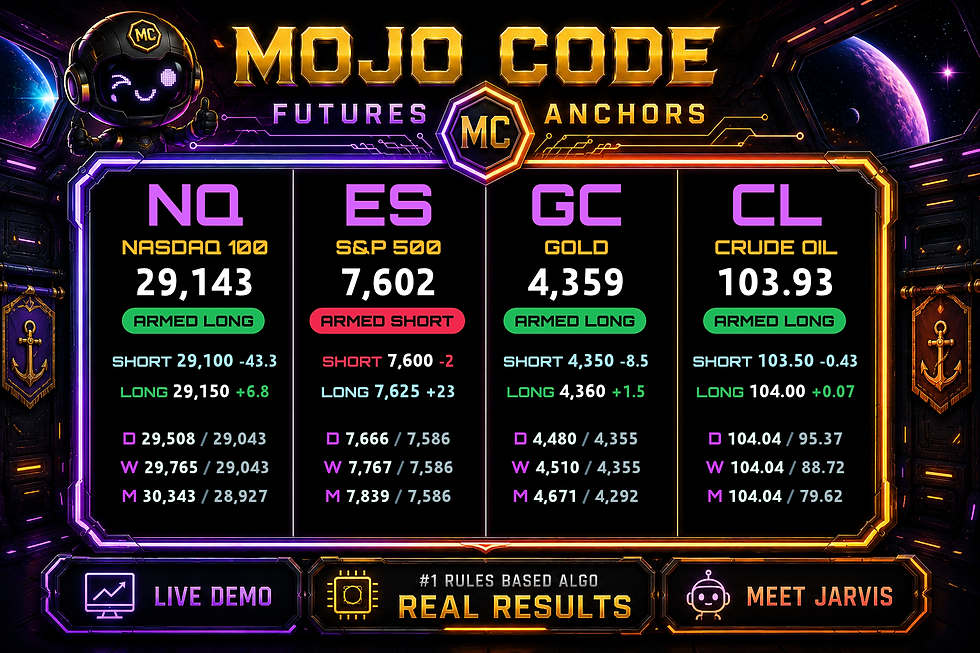
September opens with a clear directional lean across three of the four major instruments. NQ is armed long toward 29,150. ES is armed short toward 7,650. GC is armed long toward 4,420. CL is sitting flat at the midpoint, and flat in the middle means no trade — that is not a suggestion, that is the discipline. You trade toward the anchor or you sit on your hands.
The macro story underneath all of this is inflation, and it is not subtle. According to Yahoo Finance, crypto markets are selling off this morning as persistent inflation concerns weigh on risk assets, with Bitcoin and Ethereum both declining as traders reassess the environment heading into the fall.

That kind of pressure does not stay in one asset class. When inflation anxiety shows up in crypto, it is a signal about sentiment across the board. Gold reads the same tape — that is why GC is armed long. When the dollar's purchasing power is in question, the metal moves. NQ leaning long into that environment tells you growth expectations are holding, but ES fading tells you the broader index is not fully committed. This is a split-tape morning, and split-tape mornings reward traders who wait for their specific anchor to engage rather than chasing whatever looks active.
The Cage Most Stock Traders Never See
Here is what the crypto sell-off and the inflation story should make you think about if you are still trading stocks: you are operating inside a set of constraints that do not exist on this side of the market. Most stock traders absorb those constraints as normal. They are not normal. They are structural disadvantages built into the equity market that serious traders eventually leave behind.
Start with the pattern day trading rule. In the United States, if you execute four or more round-trip trades in five business days inside a margin account, and those trades represent more than six percent of your total trading activity, your broker flags you as a pattern day trader. Once flagged, you must maintain a minimum of twenty-five thousand dollars in your account at all times. Fall below that threshold and your account gets restricted. You cannot day trade your way back to twenty-five thousand when you are locked out of day trading. That is a cage, not a rule.
Then consider the margin. Stock traders get four-to-one intraday leverage on margin accounts. That sounds like a lot until you realize that futures traders are controlling instruments worth hundreds of thousands of dollars with a fraction of that as overnight margin, and the intraday margin requirements are often even lower depending on the broker and the session. The leverage structure in futures is designed for active trading. The equity margin structure is designed for investing.
Finally, there is the open. The stock market opens at 9:30 Eastern and closes at 4:00 PM. Yes, there is pre-market and after-hours access, but liquidity in those windows is thin and spreads are wide. As a practical matter, you are a 9:30-to-4:00 trader. NQ futures trade nearly around the clock. The Sunday evening open gives you a window into how global capital is repositioning before domestic equity markets ever open. That is not a small advantage. That is an entirely different relationship with price discovery.
The 60/40 Rule Nobody Explains to You
When you trade stocks and you hold for less than a year, your gains are taxed as ordinary income. That is the same rate as your salary. Most active stock traders have no idea they are handing a significant percentage of every short-term win straight to the IRS at their highest marginal rate.
Futures contracts fall under Section 1256 of the U.S. tax code. Under that treatment, sixty percent of your gains are taxed as long-term capital gains regardless of how long you held the position. Forty percent are taxed as short-term. You could hold a futures position for thirty seconds and still get that sixty percent long-term treatment. For a trader in a high income bracket, the difference between ordinary income rates and long-term capital gains rates is not trivial. It can be fifteen to twenty percentage points or more. That is real money that changes your net result without changing a single trade.
This is not financial advice and tax law varies by situation. Work with a qualified tax professional. But understand that the structural advantage exists and is worth knowing about.
Why the Constraint Drives the Decision
The point of today's lesson is not that futures are magic. The point is that serious traders migrate here because the rules are built for active trading and the stock market's rules are not. A trader who keeps blowing through their twenty-five thousand dollar PDT threshold, who watches their best setups appear at 7:00 AM when equity markets are dead, who is handing a large slice of gains to short-term tax rates — that trader is not losing because their chart reading is wrong. They are losing because the structure they are trading inside is working against them.
MOJO CODE™ is built on reading the tape through the BOPE™ lens — Built On Positive Expectancy. Positive expectancy is not just about win rate. It is about total expected value, and that includes the rules, the hours, the margin efficiency, and the tax treatment. When you factor all of it in, the serious traders who made the switch are not coming back.
Today, NQ is armed long toward 29,150, GC is armed long toward 4,420, and ES is armed short toward 7,650. CL is flat — leave it alone. Know your anchor. Know your direction. Do not trade the middle.
Trade these live with us. The VIP Room is open at 9:00 AM ET. Come see MOJO CODE™ work in real time: https://www.mojocodeai.com/vip-chat
MOJO CODE™ is a proprietary trading indicator system. Educational content only, not financial advice. Trading futures involves substantial risk of loss.
Keep it profitable,
ProTrader Mike


Comments